Malort’s Slow Boil in the Cauldron of Modernity
You used to notice a bottle of Malört tucked away in the refrigerator under the back bar, peeking out from behind the different syrups and batched cocktails. Probably in Columbus, Ohio or Indianapolis — smaller cities in the midwest, whose foodie culture was, though ascending, still firmly in Chicago’s sphere of influence.
Or maybe somewhere like Raleigh, North Carolina, or even as far west as Seattle. You’d say to the bartender, with whom you’d been casually conversing in between water glass refills, “Hey, you’ve got Malört!” And then he’d perk up a little. “You guys know Malört?” Just like that, the veil between customer and waitstaff had been pierced.
You’d say, “Yeah, we’re in town from Chicago!” and, boom, you’d be off. The bartender would tell you about a trip he took back in, like, 2012. About how the Mayan calendar thing was big that year. Gangnam Style. There was this dive bar his industry friends took him to — “oh man, we love that spot, it’s still open, actually, we were just there the other night” — where he did a shot of Malört for the first time. It was so nasty he had to procure a bottle for himself and even paid $45 extra to check his carry-on so he could bring it home and delightedly dose his coworkers. He re-ups every time he’s in town. Now, every few months or so, he’d tell you, someone in a Sox hat sits down at the bar, affectionately recognizes the piss-yellow liquid, and he gets to tell that story.
At least, you used to do that. You don’t anymore, really. The party’s over; Malört has changed. Not in the sense that the product has changed, necessarily — although conspiracy theories on the subject of the recipe persist. Rather, the proliferation of Malört into something available commercially all over the U.S. has transformed it from a fun little inside joke among hospitality-adjacent urbanites into a thoroughly known quantity: one better suited as a line item in a distributor’s spreadsheet than a niche token of intentionality.
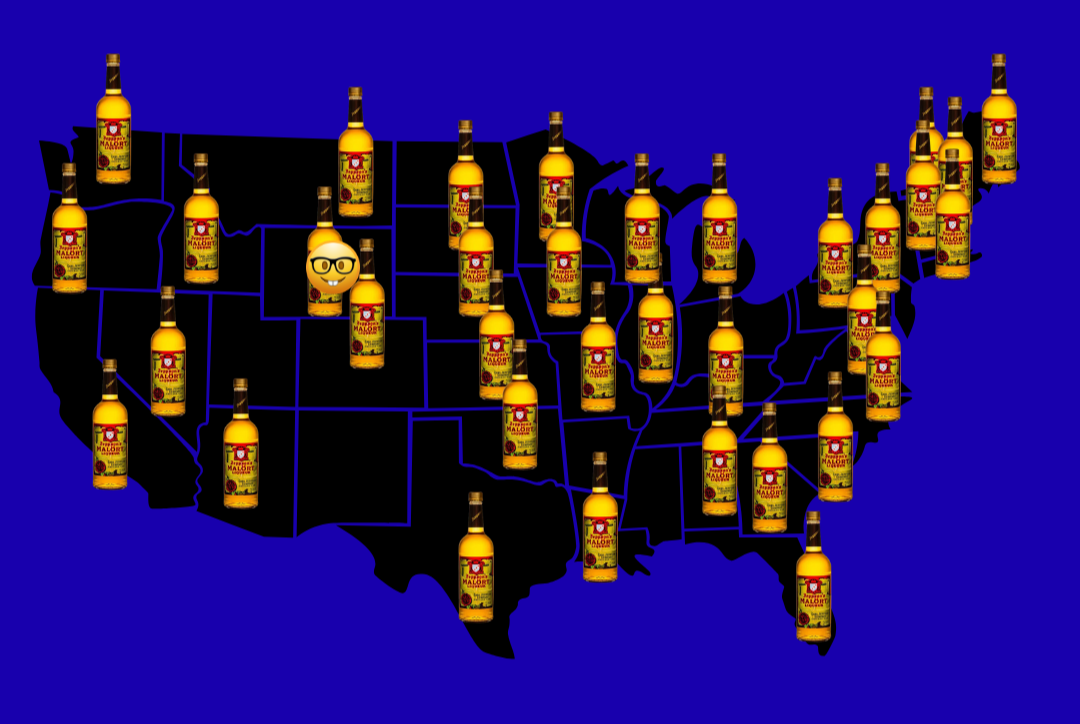
You can now find Malört in 36 different states and counting, mostly in the midwest or destinations preferred by Chicago expatriates (e.g., sunny and snow-free Arizona, Florida, and Texas, but also Colorado, Washington, and even Wyoming). You can buy it in nondescript sports bars and on the shelves of liquor stores. There’s Malört merch — once sold, unlicensed, out of Chicago bars, now available nationwide via the Malört website in the form of hockey jerseys, enamel pins, bucket hats, dog toys, pool floats, and adult onesies. There are Malört cocktails, ranging from creative mixological reaches to large-scale sports stadium activations. There are perennial Malört ad campaigns: bald-faced viral bait like Malört ice cream (by NYC-based Van Leeuwen), Malört sushi, Malört coffee, and Malört-infused Voodoo Ranger. There is so much Malört stuff that you’re now far less likely to strike up a conversation about Malört with the cool bartender than with your decidedly uncool cousin who works in tech in Denver.
And that, of course, is the whole point of the increasing marketing din involving Malört since Chicago-based CH Distillery took over in 2018: to wrest Malört from a smaller, closer-knit world of knowing smiles and shared understanding, and drag it into a world where legacy brands are increasingly exhumed from their graves and unceremoniously resuscitated for the market. A world where broad appeal overrules grassroots identity, regardless of the fact it was precisely that identity that made the thing unique in the first place. A world where everything is slowly coerced into being the same as everything else, purely in the pursuit of market share. A world where Taco Bell sells chicken nuggets.
Note: Radicchio Salad does not endorse or condone Clout Eater’s implicit derogatory statements about Taco Bell’s chicken nuggets, which, unfortunately, are good.
The chief consequence of the conversion of Chicago’s quirky hometown spirit into dorky meme shot (besides the obvious effect of the whole thing becoming thoroughly less cool) is the refinement and saturation of a product historically beloved for its explicit lack of refinement and saturation — owing to its once-charming stasis in select dives and old guy bars, where it really only ever found its way inside because someone took it upon themselves to stick a bottle in a cabinet somewhere just for the Hell of it. There was a time when Malört was free from the brand-oriented profit motive as we experience it in the 21st century. Malört is free no more.
To be clear: it’s hard to deny Malört’s newfound spotlight more or less saved it from extinction. It’s possible (maybe even likely) the brand, even in the face of a renaissance as a late-Obama-period hipster icon, wasn’t yet out of the woods when acquired by CH Distillery eight years ago. Per Josh Noel’s book on its history, the death of Malört’s owner and steward, George Brode, in 1999 — sort of the Ray Kroc to Malört’s McDonald’s, except shittier at his job — occurred while sales were already perilously low.
At the turn of the century, Brode left the brand to his secretary-turned-paramour, Pat Gabelick who, 34 years younger than Brode but no spring chicken herself, stood little chance of sustaining the operation on her own and even considered taking on a second job as a typist to make ends meet. Modernity breathing down her neck, Gabelick eventually sold Malört for over $2 million (a bargain she would likely decline to describe as Faustian) to Tremaine Atkinson, founder of CH Distillery who claimed he was dead-set on keeping things the way they were — more or less.
Either way, speculation persists that, ever since production left Florida in 2019 (and, ironically, upon its return to Chicago) something is off about the way the “new” Malört tastes. The brutal, lingering midpalate you can’t get out of your mouth — the sensation arguably more impactful than its initial taste — is said to subside quicker than it used to. The wild flavor variation from bottle to bottle, thought to be a potential consequence of shoddy Floridian production methods where the cheapest base spirit available at any given moment was the one used, is no more: all batches now taste the exact same, owing to a standardization of ingredients.
CH Distillery top brass argues that’s a good thing. They now use organic rye and locally-sourced wheat for the distillate, along with wormwood flown in from far-flung locales including the specific region in Sweden where Carl Jeppson, its quasi-creator, hailed from before immigrating to Chicago. Those are thoughtful and well-crafted touches, certainly (“If all of this makes Malört taste ‘better,’ we’re not sorry!” Tremaine has said). Yet nothing about Malört’s appeal is rooted in being thoughtful and well-crafted — certainly not if you take their ad campaigns at their word.
While it’s likely impossible to prove, on a chemical level, that Malört was deliberately made more palatable to woo drinkers in Nashville or Tampa (a cardinal Chicago sin if ever there was one), the metaphysical changes are easier to observe. When CH Distillery acquired Malört, 90% of sales were made locally. Today, Chicagoland sales are teetering towards less than half (with some goodwill lost along the way).
The owner of a bar in New Orleans (who, admittedly, was an early adopter of the whole Malört shtick) was quoted in a 2024 New York Times article on the subject of Malört losing its charm as saying: “Malört isn’t Taylor Swift. Malört is the Ramones. Both are awesome, but they’re different awesome.”
That, I don’t need to tell you, is a lame thing to say. And yet it is exactly that type of guy to whom Malört now most belongs. And it will stay with that type of guy, andworse, until Malört saturation reaches its apex, and Malört fatigue inevitably sets in. In ten years, Malört will be mentioned with the same shrugging motion as Pink Whitney or that shitty peanut butter vodka, until one day, the old-world liqueur that eked by in taverns for nearly 100 years, will end up another corny, Reddit-soaked simulacrum of what others imagine Chicago culture to be — like deep dish pizza, improv comedy, or Chicago Party Aunt.
“Oh, Malört?” you’ll hear the cool bartender say, not even dignifying you with a cursory eye-roll. “No one in Chicago even drinks that shit.”